

Why AML Expertise is the Unsung Hero of the Crypto Ecosystem
In 2026, the rules of the game have been written in permanent ink. Global regulators are no longer asking nicely. A recent analysis of crypto compliance notes that international standards now demand that every crypto firm, everywhere, must meet strict anti-money laundering and sanctions rules. This is a global baseline with no exceptions.
The cost of getting it wrong is staggering. In 2025 alone, total fines for crypto exchanges failing to meet AML standards soared past $1 billion globally. We’ve seen landmark penalties, like one major exchange being fined over $500 million, which serve as a stark warning to the entire industry. These aren’t just fines; they are direct hits to a company’s reputation and its users’ trust.
For any organization in the crypto space, this creates three critical pain points: overwhelming support tickets from confused users, severe erosion of customer trust, and the constant, gnawing fear of a compliance misstep. This is where the anti money laundering analyst steps out of the back office and into the spotlight. They are your first line of defense.

These professionals do the vital, unglamorous work that keeps the lights on. They monitor transactions, conduct deep customer due diligence, and file the reports that satisfy regulators. Their expertise directly tackles the problems of trust erosion and compliance overhead. Investing in a skilled analyst, or better yet, a team led by a certified anti money laundering specialist, isn’t a cost. It’s the strategic foundation for sustainable growth and safety. It’s how you build a business that lasts.
Building this internal expertise is a journey. For clear, actionable guidance on creating a culture of security from the ground up, check out our resource on why crypto safety matters for organizations in 2026. And to stay ahead of the curve with practical, step-by-step advice, consider subscribing to the free Clicks and Trades newsletter for regular insights.
Ready to make compliance your strength? Sign Up for more expert guidance delivered simply.
The AML Analyst: The Frontline Defender Against Financial Crime
Think of your anti money laundering analyst as your security guard in the digital finance world. They are not just a back-office role. They are your frontline defenders, the professionals who watch the gates 24/7. In simple terms, an AML analyst is responsible for monitoring financial activities to detect and investigate suspicious or illegal transactions.
For a crypto exchange or fintech company in 2026, this job is all about protecting your business from the inside out.
What Does an Anti Money Laundering Analyst Actually Do?
Their core mission is vigilance. A typical day mixes careful review, deep investigation, and clear reporting. According to career experts, the AML job description centers on monitoring transactions, identifying suspicious patterns, escalating alerts, and preparing investigation summaries.
Here’s a snapshot of their key responsibilities in the crypto space:
- Transaction Monitoring: They constantly watch the flow of funds, both on-chain (on the blockchain) and off-chain (through traditional bank transfers into your platform). They look for unusual patterns that don’t match a user’s normal behavior.
- Customer Due Diligence (CDD): This is the deep dive. Before and during a business relationship, the analyst verifies who your customers are. They check their identity, source of funds, and the nature of their activities. This process is a bit like a continuous health risk assessment for your business, ensuring every user is legitimate.
- Suspicious Activity Reporting (SAR): When something doesn’t look right, the analyst must document it thoroughly and file an official report with the relevant financial authorities. This step is critical for regulatory compliance.
The Direct Impact on Your Business Pain Points
So how does this daily grind solve the big problems you face? Let’s connect the dots.
- Reduces Overwhelming Support Tickets: A huge number of support tickets come from transaction delays or frozen accounts. A proficient AML analyst works efficiently and accurately. They clear legitimate users quickly and only flag truly suspicious activity. This means fewer frustrated customers clogging your support lines with questions about why their money is stuck.
- Protects Your Hard-Earned Reputation: Every time you prevent a single illicit transaction, you safeguard your company’s name. Your analyst is directly stopping the kind of activity that leads to headlines, fines, and a mass exodus of trusting users. They build a wall of safety that your reputation stands behind.
- Satisfies Regulators Proactively: Regulators don’t want surprises. They want to see a diligent, active compliance program. By conducting thorough CDD and filing timely SARs, your AML analyst creates a clear, auditable paper trail. This demonstrates to regulators that you are in control, turning compliance from a fear into a demonstrated strength.
In 2026, this role is more structured and vital than ever, especially in fintech where AML analyst roles are one of the most structured and predictable career paths. Investing in a skilled anti money laundering analyst isn’t just filling a job. You are deploying your most important asset for building trust and ensuring longevity.
For ongoing, plain-English guidance on navigating these complex requirements, the free Clicks and Trades newsletter breaks down crypto safety and compliance topics into simple steps. It’s a great resource for staying informed without the jargon.
Ready to strengthen your first line of defense? Sign Up for clear insights that help you build a more secure and compliant business.
Essential Skills for the Modern AML Professional in 2026
Having a strong anti money laundering analyst is one thing. Making sure they have the right tools for the job in 2026 is another. The landscape has evolved. Today’s threats are digital, cross-border, and complex. So, the skills your analyst needs have expanded far beyond basic transaction checks.
Let’s break down the essential toolkit for an effective AML professional into three key areas: technical know-how, regulatory savvy, and human-centric soft skills.
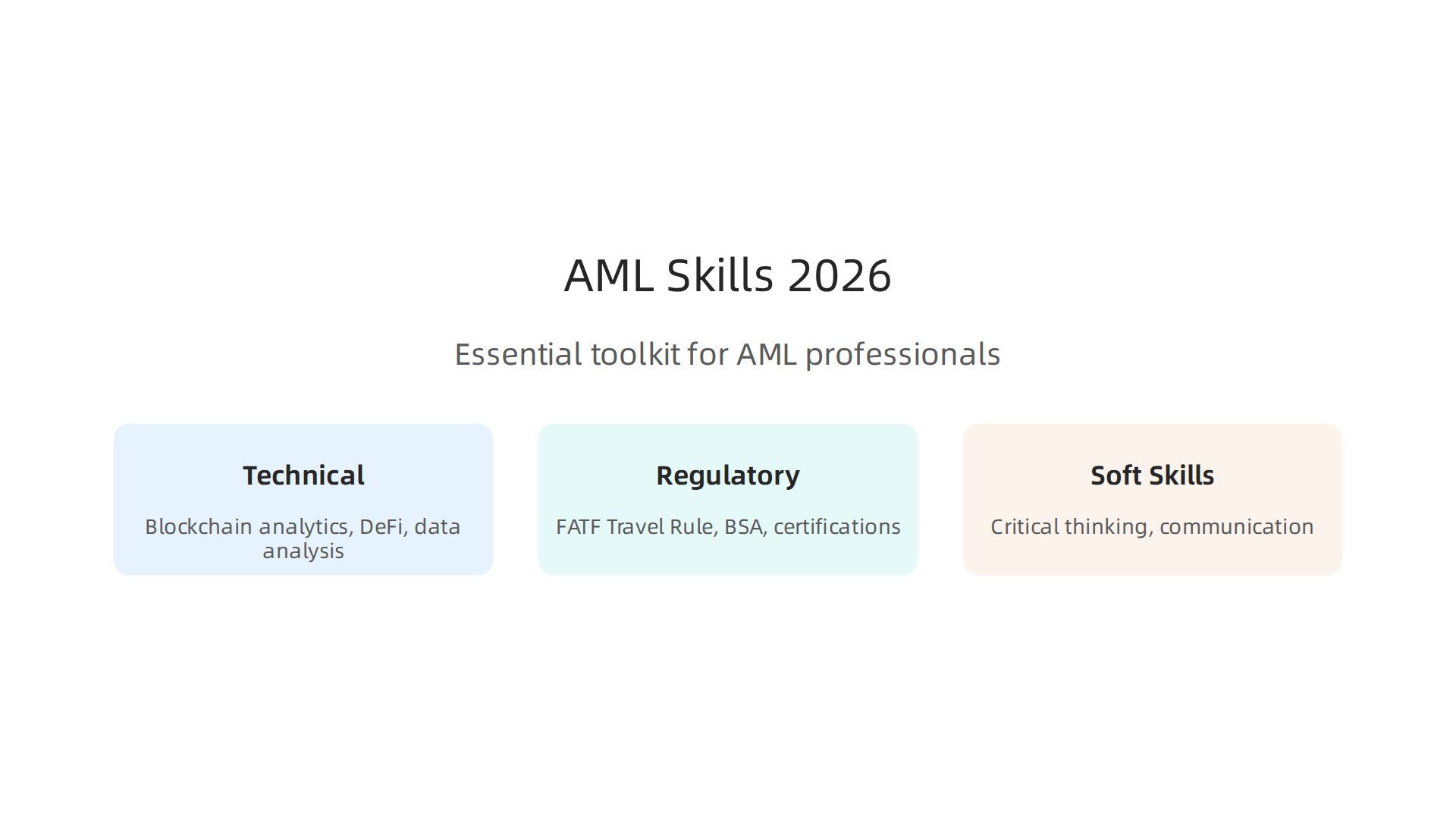
1. Technical Skills: Speaking the Language of Digital Finance
In 2026, an anti money laundering analyst must be tech-literate. Their playground is data, blockchains, and automated systems.
- Blockchain Analytics Proficiency: Simply watching traditional bank ledgers isn’t enough. Your analyst needs to trace funds on public blockchains. This means being comfortable with blockchain explorers and specialized tools that map transaction flows between wallets, helping to uncover layered transactions or funds moving to high-risk services.
- Understanding Smart Contracts & DeFi: With Decentralized Finance (DeFi) growing, analysts must grasp how smart contracts work. They need to identify if transactions are interacting with unaudited or anonymously launched protocols, which is a major red flag.
- Data Analysis Fundamentals: The role is increasingly data-driven. Basic skills in SQL (to query transaction databases) and Python (for parsing large datasets or automating simple checks) are huge advantages. These skills help an analyst move from reviewing single alerts to identifying broader, hidden patterns across your entire user base.
As career paths become more structured, these technical abilities are what allow an AML analyst to progress from basic alert review to owning complex investigative cases.
2. Regulatory Knowledge: Navigating the Global Rulebook
Rules are not static. A top-tier analyst in 2026 doesn’t just follow a checklist; they understand the "why" behind the rules and how they change.
- Must-Know Frameworks: Core knowledge includes the FATF Travel Rule (which mandates sharing sender/receiver information for crypto transfers), the recommendations from the Financial Action Task Force (FATF), and key regulations like the Bank Secrecy Act (BSA).
- Jurisdiction-Specific Nuances: Does your business serve users in Europe, Asia, and the Americas? Your analyst needs to know the specific reporting requirements, thresholds, and definitions of a Politically Exposed Person (PEP) in each region. A one-size-fits-all approach can lead to compliance gaps.
- The Value of Certification: Pursuing an anti money laundering certificate from a recognized body like the Association of Certified Anti Money Laundering Specialists (ACAMS) shows a dedicated commitment to this deep, evolving knowledge. It signals expertise to both your team and regulators.
3. Soft Skills: The Human Engine of Analysis
All the tech and rules are useless without the right person to interpret them. The irreplaceable skills are human.
- Critical Thinking & Investigative Curiosity: This is the core of the job. It’s about connecting dots.

Why is a user who typically trades $100 suddenly moving $50,000 through a mixing service? An analyst must ask "why," hypothesize, and follow a trail of digital breadcrumbs, not just close alerts that meet a simple rule.
- Clear Communication: An analyst must write detailed, factual, and coherent Suspicious Activity Reports (SARs) for regulators. They also need to explain complex issues simply to other departments, like why the legal team needs to terminate a high-risk customer’s account. This skill directly impacts your organization’s broader crypto safety posture.
Staying sharp in all these areas is a continuous journey. For straightforward insights that keep you updated on these evolving demands, the free Clicks and Trades newsletter delivers crypto safety and compliance news in plain English.
Building a team with this balanced skill set is how you transform compliance from a cost center into a true competitive advantage. It’s how you stop problems before they start.
Ready to see how a skilled AML strategy can protect your business? Sign Up for clear, actionable guidance tailored for growing crypto organizations.
Top AML Certifications: A Comparative Analysis for Career Advancement
So, you have the skills. You understand the tech and the rules. Now, how do you prove it? How do you turn your knowledge into a trusted credential that opens doors?
For an anti money laundering analyst, certifications are the gold standard. They validate your expertise to employers and build immediate trust with regulators. But with several options out there, choosing the right one can be confusing.
Here’s the thing. Not all certifications carry the same weight. Your choice should depend on your career goals, your industry focus, and your resources. Let’s break down the key factors to compare: global recognition, crypto-specific content, cost, and the time commitment required.
The Global Benchmark: CAMS from ACAMS
When people talk about an anti money laundering certificate, they are most often referring to the Certified Anti-Money Laundering Specialist (CAMS) credential. It’s offered by the Association of Certified Anti-Money Laundering Specialists (ACAMS), the largest international membership organization for AML professionals.
- Global Recognition: This is its biggest strength. CAMS is recognized by financial institutions and regulators worldwide. Having it on your resume is a clear signal that you understand global frameworks and best practices.
- Exam Structure: The CAMS exam is a rigorous test. As of 2026, it consists of 120 multiple-choice questions that you must complete in 3.5 hours. The questions cover both theoretical knowledge and practical, scenario-based problems to ensure you can apply what you know. You can review the official CAMS exam overview for the latest format details.
- Syllabus & Preparation: The syllabus is comprehensive, covering the risks and methods of money laundering, international standards, and conducting investigations. Preparation resources are widely available, including official materials and third-party guides that explain the CAMS exam format and offer preparation tips. Good news for planners: as of mid-2025, ACAMS had not announced major syllabus changes, meaning the core content remains stable for 2026.
Other Notable Certifications
While CAMS is the leader, other certifications are valuable, especially if they align with a specific niche or region.
- Certifications with Crypto Modules: The landscape is evolving. Some certifications and training programs now include modules on digital assets, blockchain analytics, and DeFi risks. This is crucial if you work in or aim to work in crypto compliance. An analyst with a traditional certification and proven crypto knowledge is in high demand.
- Specialized and Regional Credentials: Other organizations offer certifications that may be highly regarded in specific countries or sectors. These can be excellent complements to a globally recognized certification like CAMS.
Choosing the Right Path: A Practical Comparison
Your decision should balance prestige, relevance, and practicality. Here is a simplified comparison to help you think it through.
| Factor | The Industry Standard (CAMS) | Specialized/Niche Certifications |
|---|---|---|
| Global Recognition | Very High. The most widely recognized credential globally. | Varies. Can be high within a specific country, sector (like crypto), or institution. |
| Crypto/Digital Asset Focus | Traditionally broader. May require supplementing with separate crypto-specific training. | Often a core component or the entire focus of the program. |
| Cost (Approximate) | Higher. Includes membership, exam fee, and often study materials. | Lower to Moderate. Can be more affordable, especially for single-course programs. |
| Time Commitment | Significant. Requires dedicated study time (often 100+ hours) for a comprehensive exam. | Flexible. Can range from short online courses to more in-depth programs. |
Making Your Choice for Career Growth
So, which certification should you, as an aspiring or practicing anti money laundering analyst, pursue?
- For Unmatched Credibility: If your goal is to work for a large multinational bank, a global fintech, or any institution that deals with regulators across borders, CAMS is the clear choice. It’s the credential that hiring managers look for first.
- For Crypto-First Roles: If you are building a career specifically in crypto compliance, look for a certification that has strong digital asset modules. You might even consider pursuing CAMS and a specialized crypto compliance certificate to cover all bases.
- For Budget-Conscious Advancement: If you are early in your career or your employer won’t cover the cost, starting with a more focused, affordable certification can be a smart move. It shows initiative and provides foundational knowledge you can build on.
Ultimately, the best anti money laundering analyst job prospects go to those who pair certification with continuous learning. The rules change, and new threats emerge. Staying updated is non-negotiable.
For clear, ongoing insights into crypto compliance and safety trends that affect analysts every day, the free Clicks and Trades newsletter is a great resource. It breaks down complex topics into actionable information, helping you stay sharp in a fast-moving field. This kind of continuous learning supports the broader crypto safety posture that every responsible organization needs to build.
Choosing a certification is a strategic step. Think about where you want to be, what your target industry values most, and invest in the credential that will best help you get there.
Ready to map out your next career move with clear guidance? Sign Up for straightforward advice tailored for finance and crypto professionals.
CAMS (Certified Anti-Money Laundering Specialist) – The Global Benchmark
If you aim to be an anti money laundering analyst recognized anywhere in the world, the CAMS credential is your most powerful tool. Issued by the Association of Certified Anti-Money Laundering Specialists (ACAMS), this isn’t just another anti money laundering certificate. It is the industry’s gold standard, a signal to employers and regulators that you have mastered the core principles of detecting and stopping financial crime.
The exam itself is designed to test both your book knowledge and your ability to apply it. As of 2026, it is a 3.5-hour, computer-based test with 120 multiple-choice questions that cover theoretical concepts and real-world, scenario-based problems. You can review the official CAMS exam overview for the exact structure. Preparation means diving deep into a comprehensive syllabus that includes understanding the risks and methods of money laundering, international standards and frameworks, and the end-to-end process of conducting an investigation. For a clear breakdown of the CAMS exam format and helpful preparation strategies, many candidates find external guides useful.
Here’s some good news for those planning their study in 2026. As of mid-2025, ACAMS had not announced any major changes to the CAMS exam syllabus. This means the core content areas for the certification remain stable, allowing you to focus your preparation effectively. You can confirm this stability by checking the latest updates directly from the official CAMS certification page.
So, who is the typical CAMS candidate? This credential is incredibly valuable for professionals in traditional finance, like bankers or compliance officers, who want to solidify their expertise or cross over into a dedicated anti money laundering analyst job. It provides the foundational AML knowledge that is required by regulators globally. While the CAMS curriculum has traditionally focused on the broader financial system, the evolving landscape means that understanding digital assets is becoming increasingly important. The certification body and preparation materials are continually updating to include considerations for crypto, reflecting its role in modern financial crime.
Earning your Certified Anti-Money Laundering Specialist designation does more than boost your resume. It equips you with the framework to help build a stronger organizational defense, contributing directly to a robust crypto safety posture that protects against evolving threats.
The field never stops changing. Pairing your certification with continuous learning is key. For clear, ongoing insights that break down complex crypto compliance and safety trends, consider subscribing to the free Clicks and Trades newsletter. It’s a straightforward way to stay sharp and informed.
Ready to get clear, step-by-step guidance for your career in finance and crypto? Sign Up for straightforward advice tailored for professionals like you.
CCA (Cryptocurrency Compliance Analyst) – The Specialist Credential
While CAMS gives you a powerful global foundation, the crypto world demands its own specialized language. This is where the Cryptocurrency Compliance Analyst (CCA) credential comes in. Think of it as the leading anti money laundering certificate built specifically for the digital asset age.
If you want to be an anti money laundering analyst who truly understands crypto, this is your path. The CCA program zooms in on the unique challenges you won’t find in traditional finance. Its core coverage includes:
- Blockchain Forensics: Learning to trace transactions on public ledgers, understanding mixing services, and identifying patterns of illicit activity.
- The Crypto Regulatory Landscape: Navigating the evolving patchwork of global regulations that apply to virtual asset service providers (VASPs).
- Practical Risk Assessment for VASPs: Applying know-your-customer (KYC) and transaction monitoring principles specifically to exchanges, wallet providers, and other crypto businesses.
This credential is targeted. It’s perfect for professionals already working in crypto who need to formalize their expertise, or for those in traditional finance looking to pivot into a dedicated anti money laundering analyst job within the digital asset sector. It signals to employers that you have the precise skills to protect an organization’s crypto safety posture against modern, blockchain-based threats.
The field moves fast. Earning a specialized certification like the CCA is a major step, but pairing it with continuous, practical learning is what keeps you effective. For clear, ongoing insights that break down complex crypto compliance and safety trends in simple terms, subscribing to the free Clicks and Trades newsletter is a great habit. It delivers step-by-step guidance straight to your inbox.
Ready to get clear, step-by-step guidance for your career in finance and crypto? Sign Up for straightforward advice tailored for professionals like you.
AML Career Paths: From Analyst to Leadership
So you’ve got the certifications, or you’re working toward them. What comes next? A career as an anti money laundering analyst isn’t a dead-end job. It’s the first step on a structured, rewarding ladder with clear progression.

In 2026, the demand for skilled professionals continues to grow, especially in fintech and crypto. Let’s map out the typical journey from your first anti money laundering analyst job to the executive suite.
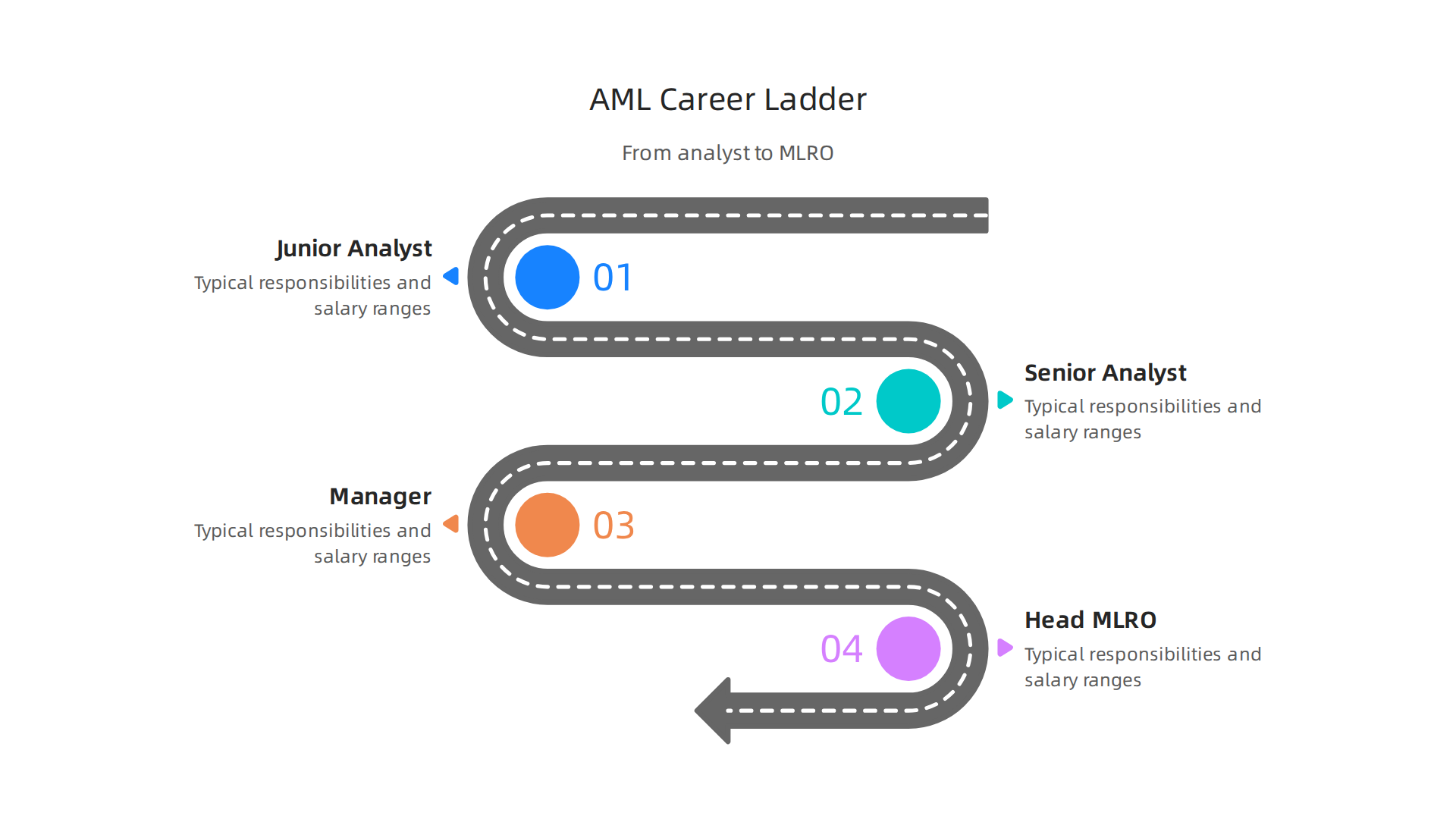
The Standard Progression Ladder
1. Junior/Entry-Level AML Analyst
This is where you start. You’ll handle day-to-day tasks like monitoring transaction alerts, conducting initial customer due diligence (CDD) reviews, and filing basic suspicious activity reports (SARs). Your focus is on learning the systems, regulations, and processes. According to recent data, an entry-level anti money laundering analyst can expect a global average salary between $55,000 and $75,000 annually. This role is about building a strong foundation.
2. Senior AML Analyst or AML Officer
After 2-4 years, you’ll move up. Here, your responsibilities deepen. You’ll investigate complex cases, make risk-based decisions on whether to file SARs, mentor junior staff, and may start specializing in areas like sanctions or high-risk customers. Your strategic thinking becomes crucial. This is often the stage where professionals solidify their status by earning a key anti money laundering certificate like the CAMS.
3. AML Manager / Team Lead
Now you’re leading. You manage a team of analysts, oversee the daily workflow, ensure regulatory deadlines are met, and act as the bridge between your team and upper management. You’re responsible for the quality and efficiency of your unit’s output. In the UK for 2026, an AML/Financial Crime Manager can command a salary between £85,000 and £110,000. Your focus shifts from doing the work to enabling your team to do it effectively.
4. Head of Compliance / Money Laundering Reporting Officer (MLRO)
This is a leadership role with personal liability. As Head of AML or the MLRO, you own the entire compliance program. You report directly to the board, interact with regulators, set the strategic direction for financial crime prevention, and are the ultimate sign-off on major filings. The salary reflects the significant responsibility. In 2026, Heads of AML and MLROs often sit in the $160k–$220k+ range in the US, with similar high figures in major financial hubs like London.
Beyond the Ladder: Alternative & Specialized Paths
The path isn’t always straight up. Many professionals branch into lucrative specializations that build on their core analyst skills.
- Blockchain Intelligence Specialist: This is a natural pivot for analysts curious about crypto. You’ll use forensic tools to trace illicit funds on the blockchain, a skill critical for any modern organization’s crypto safety posture.
- Sanctions Compliance Expert: With global sanctions regimes constantly evolving, specialists who can navigate these complex lists and implement controls are in high demand.
- Regulatory Affairs & Policy: If you love the "why" behind the rules, you can move into helping shape policy or guiding a firm through new regulatory landscapes.
- Consultancy: Experienced analysts and managers are highly valued by consulting firms that advise banks, fintechs, and crypto businesses on building and testing their compliance programs.
No matter which path you choose, continuous learning is non-negotiable. The rules change, new typologies emerge, and technology evolves. For clear, ongoing insights that break down complex crypto compliance and safety trends in simple terms, subscribing to the free Clicks and Trades newsletter is a smart way to stay informed. It delivers practical guidance straight to your inbox.
Ready to get clear, step-by-step guidance for your career in finance and crypto? Sign Up for straightforward advice tailored for professionals like you.
Salary Expectations and Market Demand in the Crypto-Fintech Era
Knowing the career ladder is one thing. Knowing what you can earn on each rung is another. In 2026, the market for anti money laundering analysts is strong, and salaries reflect the high demand and specialized skills required. Let’s break down the numbers and the forces driving them.
Current Salary Benchmarks
Your pay as an anti money laundering analyst depends on your experience, location, and crucially, whether you hold a recognized anti money laundering certificate. Here is a snapshot for 2026:
- Entry-Level AML Analyst: This is your first anti money laundering analyst job. Globally, you can expect an average annual salary between $55,000 and $75,000. Your main task is building a strong foundation in monitoring and due diligence.
- Senior AML Analyst/Officer: With 2-4 years of experience, salaries increase significantly. In the United States, the average compensation for AML compliance roles is around $98,949 per year. Specializing in high-risk areas like crypto can command a premium.
- AML Manager/Team Lead: Leadership brings higher rewards. In the UK, an AML/Financial Crime Manager earns between £85,000 and £110,000 according to the latest industry data. In the US, salaries for this level are comfortably into six figures.
- Head of AML / MLRO: At the executive level, compensation reflects serious responsibility. Heads of AML and MLROs often sit in the $160k–$220k+ range in the US. In major hubs like London, MLRO salaries can range from £140,500 to £194,500.
Why Demand is Sky-High in 2026
Three major forces are creating more jobs for AML professionals than ever before:
- Regulatory Tightening: Global regulators are imposing stricter rules on both traditional finance and the crypto sector. Every new regulation requires more people to implement and monitor it.
- Crypto’s Mainstream March: As crypto-native businesses grow and traditional banks offer crypto services, the need for experts who understand blockchain risks is exploding. This makes an organization’s overall crypto safety posture a top business priority, directly creating AML jobs.
- The Fintech Boom: The expansion of fintech companies, all of which need compliance teams, continues to fuel hiring. Reports show sustained demand across fintech job listings for AML analysts and compliance officers.
The Certification Advantage
Here’s a key insight for 2026: there is a significant talent gap. There are more open AML roles than there are qualified professionals to fill them. This is where certification becomes your biggest advantage.
A credential from a body like the Association of Certified Anti Money Laundering Specialists (ACAMS), which grants the Certified Anti-Money Laundering Specialist (CAMS) title, is more than a line on your resume. It’s a verified signal of your expertise and commitment. Certified professionals often secure higher starting salaries, win promotions faster, and are prioritized for specialized roles in high-demand areas like crypto compliance.
In this competitive market, continuous learning isn’t optional. The landscape shifts too quickly. For clear, ongoing insights that break down complex crypto compliance and safety trends in simple terms, subscribing to the free Clicks and Trades newsletter is a smart way to stay ahead. It delivers practical guidance straight to your inbox.
Ready to get clear, step-by-step guidance for your career in finance and crypto? Sign Up for straightforward advice tailored for professionals like you.
The Future of AML: AI, RegTech, and Evolving Skill Sets
The role of an anti money laundering analyst is not staying the same. In 2026, technology is not just a tool. It is reshaping the entire profession. The good news? This change makes you more valuable, not less. It turns you from someone who just reviews alerts into a strategic advisor who manages intelligent systems.
Here is what is changing and how you can stay ahead.
Artificial Intelligence Is Your New Partner
Think about the main pain point for any anti money laundering analyst. It is the mountain of alerts, many of which are false positives. Artificial Intelligence and Machine Learning are now tackling this head on.
AI systems use data and speed to dramatically reduce fraud incidents and catch them faster. They are moving beyond simple rules to learn complex, hidden patterns of criminal activity.
What does this look like in your daily work?
- Smarter Alert Triage: AI can prioritize alerts for you, pushing the most suspicious cases to the top of your queue. This means you spend time on real risks, not noise.
- Predictive Risk Scoring: Instead of static customer profiles, AI continuously updates risk scores based on real time transaction behavior and external data.
- Automated Processes: Tasks like identity verification are becoming faster and more secure with AI powered AML systems.
This shift means your job is less about manual review and more about overseeing, tuning, and interpreting the outputs of these powerful systems.
The Rise of Specialized RegTech
This is where Regulatory Technology, or RegTech, comes in. For fighting financial crime in crypto and digital assets, specialized tools are essential. These platforms offer blockchain analytics and transaction monitoring designed for the digital age.
Modern AML software in 2026 uses machine learning for transaction monitoring to enhance detection. The best tools provide a clear, visual map of transaction flows across wallets and exchanges. This is critical for understanding a company’s overall crypto safety posture and investigating complex cases.
Your skill set needs to include knowing how to use these platforms. You do not need to be a programmer. You need to be a power user who can ask the right questions and understand the answers the software provides.
How to Future Proof Your Career
So, what should you do? Embrace the technology. Do not fear it. Your human judgment, ethical reasoning, and investigative curiosity are what make AI effective.
- Become Tech Curious: Take online courses on the basics of AI and blockchain. You do not need to code. You need to understand what the technology can and cannot do.
- Get Hands On: Whenever possible, volunteer for projects involving new compliance software at your job. Be the person who learns the new tool first.
- Strengthen Your Core: Technology changes, but core principles do not. A solid foundation from a recognized body like the Association of Certified Anti Money Laundering Specialists (ACAMS) is more important than ever. Becoming a certified anti money laundering specialist proves you understand the rules that the technology is built to enforce.
- Focus on Analysis: Your value is in connecting dots, understanding context, and making final decisions. Sharpen your analytical and communication skills to explain complex findings to non technical colleagues.
The future for an anti money laundering analyst is bright. It is a hybrid role, part financial detective and part technology strategist. By leaning into these changes, you secure your place at the forefront of the field.
The landscape evolves fast. For clear, ongoing insights that break down these tech and compliance trends in simple terms, subscribing to the free Clicks and Trades newsletter is a smart way to stay informed. It delivers practical guidance straight to your inbox.
Ready to get clear, step-by-step guidance for your career in finance and crypto? Sign Up for straightforward advice tailored for professionals like you.
Summary
This article explains why anti‑money‑laundering (AML) expertise is now central to any crypto or fintech business and shows how skilled AML analysts protect companies from fines, reputational damage, and operational pain. It outlines the day‑to‑day responsibilities of AML analysts—transaction monitoring, customer due diligence, and filing suspicious activity reports—and links those tasks directly to fewer support tickets, stronger customer trust, and demonstrable regulatory compliance. The piece breaks down the mix of technical skills (blockchain analytics, SQL/Python), regulatory knowledge, and soft skills that modern analysts need, and compares top certifications like CAMS and crypto‑specific credentials. It maps realistic career paths and salary ranges from entry analyst to MLRO and shows how AI and RegTech are changing the role into one of oversight and strategy. The article gives practical advice on choosing certifications, future‑proofing your skills, and treating AML as an investment in business resilience rather than a cost.