

Why Proactive Health Risk Assessment is Non-Negotiable for Crypto-Focused Businesses
Imagine your lead developer. It’s 3 a.m., markets are moving fast, and they’re on their fifth coffee.

The pressure to monitor positions, react to news, and secure assets is relentless. This isn’t just a demanding job; it’s an environment where traditional workplace health risks are amplified to the extreme.
In the crypto world, the stakes are always high. The 24/7 nature of the industry, coupled with significant financial volatility, creates a perfect storm for stress, burnout, and mental fatigue.
This high-pressure environment doesn’t just affect personal well-being. It directly impacts your business’s core pillars: security, compliance, and your ability to keep top talent.
Think about it. A stressed, tired employee is more likely to make a costly security error, like mishandling private keys or falling for a sophisticated phishing attack. Proactive health risk management isn’t just about being a good employer; it’s a critical business defense strategy. A formal health risk assessment process helps you see these interconnected threats clearly.
Following frameworks from leading safety authorities, a structured approach turns these abstract dangers into a list of items you can actually manage. It starts with identifying hazards—like chronic stress or poor ergonomics for those long trading sessions. Then, you can implement controls, following a proven method for ranking safeguards to protect your team. You can learn more about building this kind of proactive safety culture in our guide on why crypto safety matters for organizations in 2026.
Without this process, you’re managing blind. With it, you build a more resilient, secure, and attractive organization. It moves you from hoping for the best to planning for success.
Ready to build a safer, stronger foundation for your team? Get clear, step-by-step guidance on managing both digital and human risk factors. Sign up for the free Clicks and Trades newsletter for straightforward crypto education and practical safety tips delivered to your inbox.
Defining Health Risk Assessment in the Modern Crypto Workplace
So, what exactly is a health risk assessment today? It’s more than just checking for wet floors or loose wires. In 2026, a true Health Risk Assessment, or HRA, looks at the whole picture. It goes beyond physical safety to include psychological, ergonomic, and digital well-being.
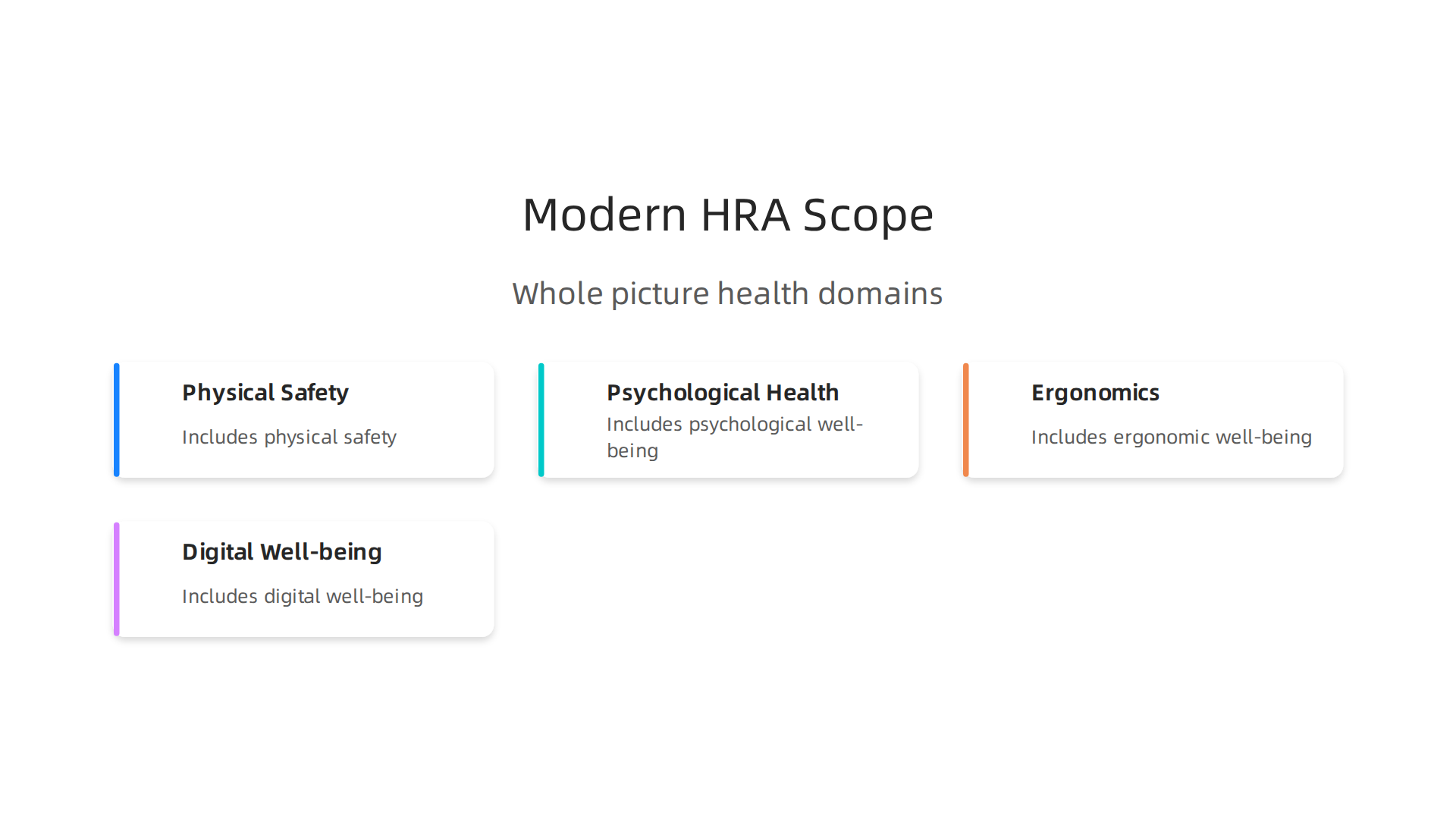
Think of it as a full check-up for your workplace environment and how it affects your team.
For a crypto-focused business, this scope is critical. You can’t just assess for old-fashioned hazards. Your assessment must include the unique risks that come with the territory. This means evaluating the mental strain from the need for constant vigilance against scams and hacks. It includes the stress from direct exposure to financial fraud and the emotional rollercoaster of asset volatility. Even the physical setup for those long, screen-heavy trading sessions needs a close look. Modern frameworks show that these factors are deeply interconnected, where stress from one area can amplify risks in another.
A formal HRA process gives you something priceless: a baseline. It turns vague concerns into clear metrics. You start by identifying all the hazards, from chronic anxiety to poor desk posture. Then, you can follow proven methods, like the hierarchy of controls, to rank and implement the best safeguards. This structured approach is what builds a robust safety and health program. You can see how protecting your team’s digital assets is part of this holistic safety mission in our guide on why your organization’s wallet choices matter in 2026.
Without this baseline, your wellness initiatives are just guesses. With it, you can measure real impact. Did the new flexible schedule reduce error rates in transaction monitoring? Did ergonomic upgrades lower complaints of fatigue? A formal HRA tells you. It’s the foundation that lets you manage human risk with the same seriousness as you manage market risk.
Managing all these interconnected risks can feel complex. If you want straightforward, step-by-step guidance on building safety from the ground up, consider subscribing to the free Clicks and Trades newsletter. It delivers clear crypto education and practical tips to help you and your team stay secure.
The Unique Health Risk Profile of Crypto Organizations
What keeps your team up at night in 2026? For most crypto teams, it’s not just market dips. It’s a unique mix of intense pressures that creates a health risk profile unlike any other traditional industry. A thorough health risk assessment for your organization must look beyond the screen to understand these four critical areas.
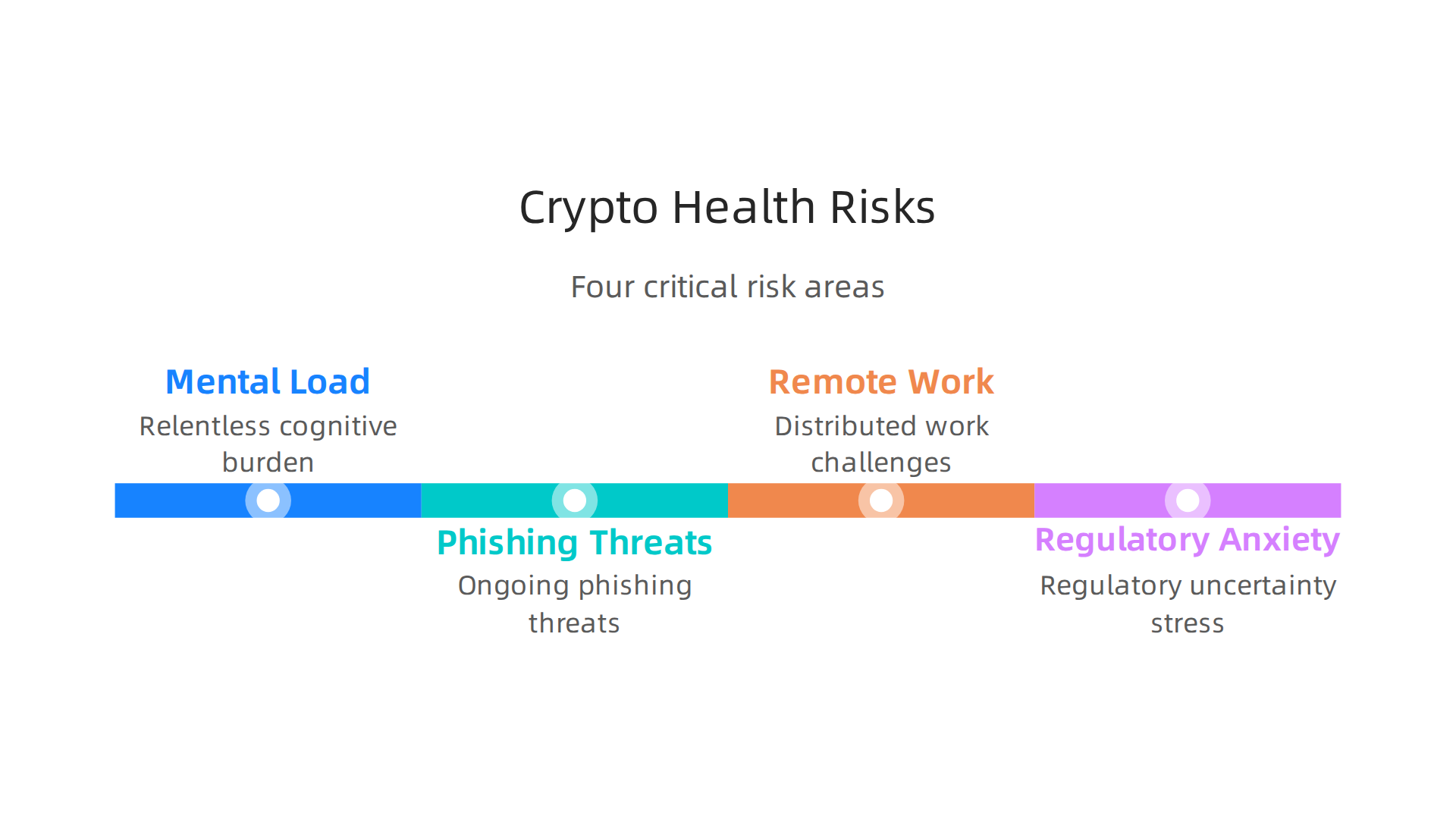
The Relentless Mental Load and Burnout
Crypto never sleeps. The 24/7 global market and a constant threat landscape of hacks and scams create chronic stress and decision fatigue. Your team is making high-stakes decisions while on constant alert. This isn’t just tiring. It’s a direct path to burnout.
Research shows this is a sector-wide issue. A recent survey found that nearly half of organizations report their security and risk teams experience burnout. In fintech and crypto teams, this burnout shows up as increased errors, cynicism, and a drop in the vigilance you rely on. A proper health risk assessment needs to measure this mental strain, not just count sick days.
The Target on Their Backs: Phishing and Social Engineering
In many jobs, a phishing email is a nuisance. In crypto, an employee is a high-value target. Every day, your team members face sophisticated attempts to trick them into giving up access or funds. This isn’t just an IT problem. It creates unique psychological pressure. The fear of making a single costly mistake can be paralyzing.
This turns everyday communication into a source of stress. A holistic security and risk assessment must therefore include the human toll of being a perpetual target. Protecting your team’s mental space is as important as protecting your wallets.
The Double-Edged Sword of Remote and Async Work
Crypto organizations often champion remote work. But this flexibility comes with hidden health risks. Isolation, blurred lines between work and home life, and inconsistent support systems can quietly erode well-being. Without a physical office, signs of struggle are harder to spot.
Team members might feel alone with their stress or feel pressured to be always "on" to prove they’re working. Your health risk assessment must ask: Do our remote work policies protect people, or do they accidentally encourage unsustainable habits?
The Cloud of Regulatory Anxiety
The rules of the game keep changing. The shifting compliance landscape in 2026 creates a pervasive sense of uncertainty. Will today’s strategy be compliant tomorrow? This regulatory anxiety adds a background hum of stress that affects everyone, from the compliance officer to the developer.
This anxiety is compounded by broader economic trends, where workers across sectors report heightened job security fears. In a high-stakes field like crypto, this anxiety can amplify other risks, making a measured, careful health risk assessment even more vital for stability.
Understanding these interconnected risks is the first step to building a safer, healthier workplace. It’s about creating a culture where security is sustainable. For more on building that foundational culture, explore our guide on why crypto safety matters for organizations in 2026.
Feeling overwhelmed by where to start with your team’s safety education? You don’t have to build it alone. Get clear, step-by-step guidance delivered directly to you. Sign Up for the free Clicks and Trades newsletter for straightforward crypto security tips and practical advice to help your entire team stay sharp and secure.
A Step-by-Step Framework for Conducting Your HRA
Understanding the unique risks is one thing. How do you turn those insights into an actual plan? A proper health risk assessment isn’t just a box to check. It’s a living process. This five-step framework will help you move from awareness to action, building a safer and more resilient team.
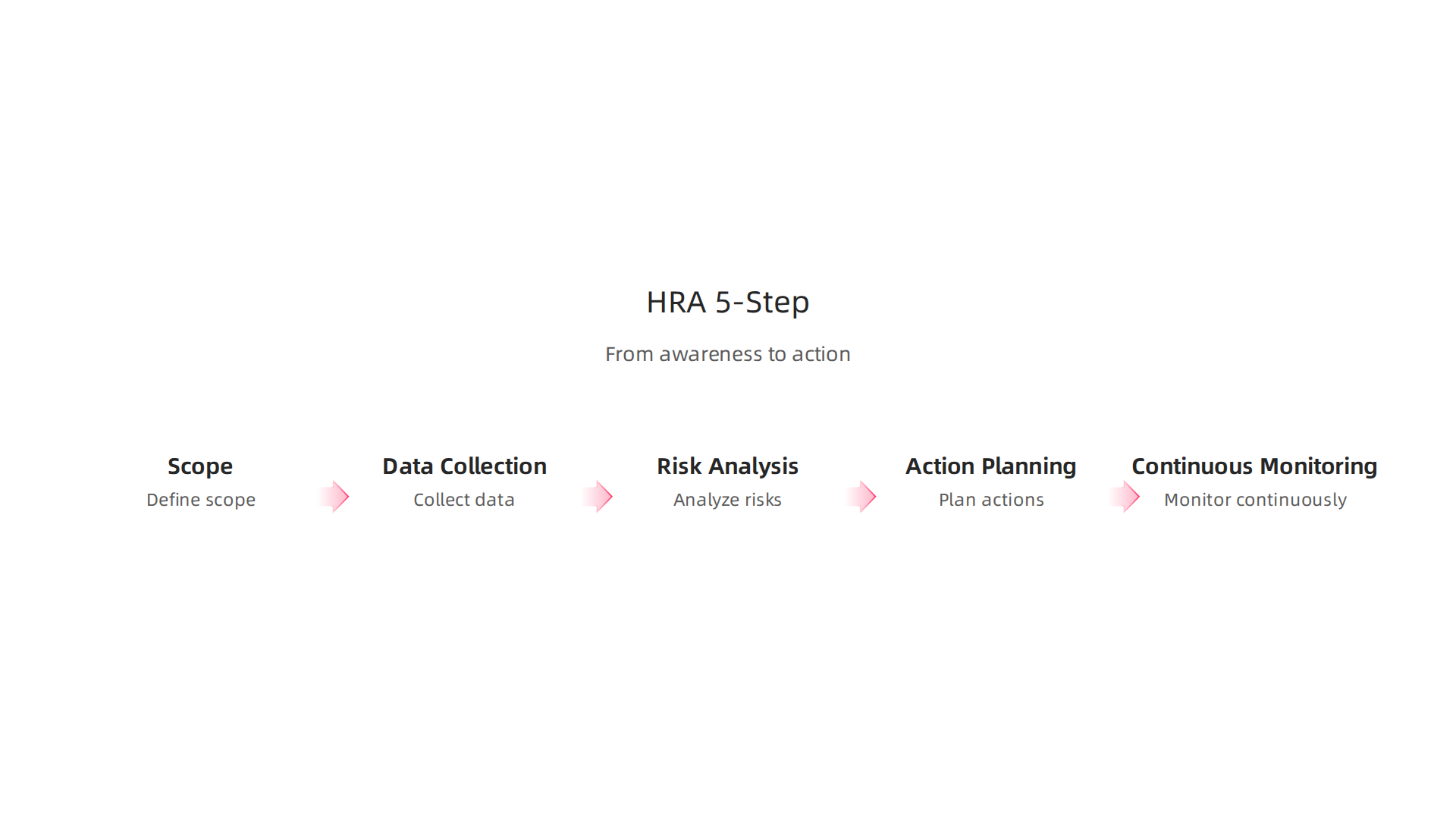
Step 1: Scope & Objective Setting – Aligning with Your Goals
Start with the "why." A useful HRA must tie directly to your business goals. Are you focused on reducing security incidents? Improving employee retention? Or ensuring compliance in the shifting regulatory landscape of 2026?
Defining your scope means answering key questions. Which teams are involved? Are you assessing mental health risks, physical security pressures, or both? Clear objectives turn your assessment from a vague wellness check into a strategic tool. For instance, aligning your HRA with a formal safety program structure, like those outlined in guides such as the OSHA Safety Champions Program, can provide a robust framework for integrating health and safety goals.
Step 2: Data Collection – Listening Without Fear
This is where you gather the truth. You need honest data about stress, burnout, and security anxieties. Anonymous surveys are a powerful starting point. They let team members share pressures they might not say aloud.
Complement surveys with small, confidential focus groups. Listen for the stories behind the statistics. Also, analyze past incident reports. A spike in human errors might point to chronic fatigue. The goal is to create multiple safe channels for feedback. Remember, protecting your team’s security culture starts with understanding their experience.
For more practical guidance on building that foundational culture of safety, our guide on why crypto safety matters for organizations in 2026 is a great next read. And for clear, step-by-step security tips you can share with your whole team, consider the free Clicks and Trades newsletter.
Step 3: Risk Analysis & Prioritization – What Matters Most?
You’ll likely identify many potential issues. Now, you need to sort them. A standard method is to score each risk on two factors: how likely it is to happen, and what the impact would be on your business.
Create a simple matrix. High likelihood, high impact risks go to the top of your list. For example, "burnout leading to a catastrophic security oversight" is a high-priority risk. "Occasional workplace annoyance" is lower priority. This step, as noted in risk management principles, is all about moving from simple identification to careful evaluation so you can focus your energy where it matters most.
Step 4: Action Planning – Targeted Interventions
For each high-priority risk, develop a specific action plan. If survey data shows extreme phishing anxiety, your plan could include specialized training and implementing stricter email filters. If remote work isolation is a key issue, your plan might introduce virtual co-working sessions or mental health days.
Think of these as your control measures. The key is that plans are targeted and actionable. Instead of "reduce stress," a better plan is "launch a quarterly, anonymous stress pulse survey and provide access to confidential counseling services by Q3."
Step 5: Implementation & Continuous Monitoring – Making It Stick
A plan on paper changes nothing. Assign clear owners for each action item and set deadlines. Then, build monitoring into your regular operations. This could be a quarterly review of survey trends or a monthly check-in on action plan progress.
The regulatory and threat landscape changes constantly. Your health risk assessment must be a cycle, not a one-time event. By making it part of your regular security and operational reviews, you ensure your team’s well-being is always part of the conversation, helping you protect your most important asset: your people.
Ready to take the next step in securing your organization’s foundation? A crucial part of overall risk management is ensuring your team uses secure tools. Learn more about this in our guide on why wallet choices matter for organizations in 2026.
Building a comprehensive safety program can feel complex, but you don’t have to do it alone. For straightforward, practical advice on crypto security that you can implement right away, Sign Up for the free Clicks and Trades newsletter. Get clear guidance delivered directly to you, helping your entire team stay sharp and secure.
Tailoring the Framework for Key Crypto Roles
A standard health risk assessment process is a great start. But in 2026, a one-size-fits-all approach won’t work. The unique pressures on different crypto roles require specific attention. Here’s how to adapt your framework.

For Customer Support Teams: Assessing Emotional Toll
These frontline staff often handle traumatic cases. They speak to users who have lost life savings to scams. A tailored security risk assessment for them must look beyond repetitive stress. It should screen for secondary trauma and compassion fatigue. Questions in your surveys should probe their emotional state after difficult interactions. Offering confidential counseling access is a crucial control measure. High anxiety in the broader workforce, as noted in recent economic reports, can make these roles even more draining.
For Security & Developer Teams: Evaluating Burnout from Constant Vigilance
Your guardians face a different battle. They are on constant alert for threats, often working punishing on-call schedules. Recent data shows that nearly half of organizations report their security and risk assessment teams experience burnout. For these teams, your health risk assessment must evaluate sleep disruption, the psychological impact of threat exposure, and the risk of alert fatigue leading to costly mistakes. Implementing strict rotation schedules for on-call duties and mandating true time-off are non-negotiable interventions.
For Executive Leadership: Identifying Decision Fatigue & Scrutiny
Leaders in crypto operate under a microscope, making high-stakes calls with immense pressure. Your framework should assess risks tied to decision-making under duress, public scrutiny, and the intense isolation of leadership. This is less about physical safety and more about a strategic risk assessment for mental resilience. Ensuring executives have access to peer advisory groups and executive coaching can be a vital part of the action plan.
A robust safety culture, supported by structured programs, is the foundation for addressing these diverse risks. Integrating your tailored health risk assessment into a broader program, like those outlined in guides from OSHA, can ensure consistency and effectiveness across all roles.
Building a resilient team starts with understanding their specific challenges. For more on creating that foundational culture of safety, read our guide on why crypto safety matters for organizations in 2026. And for clear, practical security advice you can share across your entire organization—from support to leadership—the free Clicks and Trades newsletter is an excellent resource for ongoing education.
Sign Up for the free Clicks and Trades newsletter today. Get straightforward crypto security guidance delivered to you, helping every team in your organization stay protected and perform at their best.
Specialized Applications: Integrating HRA with Crypto-Specific Programs
Creating tailored health risk assessments is only half the battle. The real power comes from using that data to supercharge your existing programs. In 2026, the smartest crypto organizations are moving beyond checking a box. They are integrating their health risk assessment findings directly into core operations to build genuine resilience. Here’s how you can apply this data for maximum impact.
Application 1: Bolstering Security Training & Culture
Your health risk assessment can reveal critical stress points. For example, if data shows your security team is suffering from high alert fatigue, generic training won’t fix it. Instead, use those insights to design targeted interventions.
You can reshape your security protocols. If assessment data indicates that complex procedures are being skipped due to mental exhaustion, you can simplify them. You can also schedule critical security drills for times when your team’s cognitive risk is lowest, not highest. This turns your health risk assessment from a report into a tool for reducing human error. It moves your security and risk assessment strategy from purely technical to human-centric, making your entire operation more secure. Building this culture starts with leadership understanding its importance, which is detailed in our guide on why crypto safety matters for organizations in 2026.
Application 2: Informing Employee Benefits & Wellness Offerings
Many companies offer wellness programs, but a 2025 study highlighted a critical gap between their implementation and how employees perceive their value. Your health risk assessment data bridges this gap. It tells you exactly what your team needs.
Instead of guessing, you can direct resources precisely. If your assessment shows customer support staff report high secondary trauma, you can fund specific, confidential counseling services. If developers show signs of sleep disruption, you can provide subscriptions to sleep and mindfulness apps. This data-driven approach ensures your benefits are impactful, not just a generic perk. As noted in reports on the future of wellness, leaders in 2026 want to see real outcomes from their investments. Your health risk assessment provides the roadmap to get there.
Application 3: Supporting Regulatory Compliance & Reporting
The regulatory landscape for crypto is maturing. Authorities are increasingly looking at how companies protect not just user assets, but also their own people who handle those assets. A systematic health risk assessment demonstrates a proactive duty of care.
It provides documented evidence that you are identifying and mitigating workplace psychosocial risks, such as the extreme stress of handling irreversible financial transactions. This is not just about employee health. It becomes part of a broader strategic risk assessment for your organization’s sustainability and legal standing. Having this process in place shows regulators and investors that you manage human capital risks with the same seriousness as technological and financial risks.
Integrating your health risk assessment deeply into these areas transforms it from an administrative task into a strategic asset. For clear, ongoing guidance on building security-aware habits across your team, the free Clicks and Trades newsletter is a trusted resource for practical, jargon-free advice.
Sign Up for the free Clicks and Trades newsletter. Get straightforward crypto security and operational guidance delivered to you, helping you build a safer, more resilient organization.
Measuring Success: KPIs and ROI of a Proactive HRA
You have integrated your health risk assessment into security, benefits, and compliance. Great. But in 2026, leaders need more than good ideas. They need proof. How do you show that your proactive health risk assessment is actually working? You track the right numbers.
Think of it like a security risk assessment for your people. You wouldn’t just install a firewall and never check the logs. You measure to see if attacks are being blocked. The same logic applies here. You need to see if your efforts are reducing human risk.
The Leading Indicators: Are People Engaging?
Leading indicators tell you if you’re on the right track. They measure activity and perception before a major problem occurs.
- Employee Participation: Are people actually using the wellness programs you launched based on the HRA data? High participation is a strong early sign of trust and relevance.
- Survey Score Trends: Conduct follow-up pulse surveys. Are the average scores for stress, fatigue, or psychological safety improving over time? This shows if your interventions are making a daily difference.
- Feedback Quality: As noted in research on workplace wellness, a 2025 study highlighted a persistent gap between simply having programs and employees finding real value in them. Positive, specific feedback in interviews or anonymous channels is a golden leading indicator.
Tracking these helps you adjust quickly. If participation is low, maybe your messaging is off. If scores aren’t improving, a specific intervention might need a change. This turns your health risk assessment into a living, responsive tool.
The Lagging Indicators: Are We Safer and Stronger?
Lagging indicators show the ultimate outcome. They are the result of all your efforts, visible after some time has passed. These are the numbers that will convince your CFO.
- Reduction in Human-Error Incidents: This is critical for crypto. Compare the rate of security incidents, mistaken transactions, or procedural slips caused by human factors before and after your targeted training and protocol changes. A drop here is a direct win for your security and risk assessment posture.
- Lower Turnover in High-Stress Roles: Are your key security engineers, compliance officers, or customer support staff staying longer? Reduced voluntary turnover in high-burnout roles saves massive recruitment and training costs.
- Decreased Absenteeism: Look at unplanned leave, especially for mental health or stress-related reasons. A downward trend means your team is more resilient.
These metrics move slowly but prove real impact. They show your health risk assessment isn’t just about feeling better. It’s about creating a more reliable, stable, and secure organization.

For a deeper look at building this resilient culture from the top, our guide on why crypto safety matters for organizations explores the leadership mindset needed.
Calculating the Tangible ROI
In 2026, data must connect to dollars. Calculating the Return on Investment (ROI) of your health risk assessment moves it from a cost center to a strategic investment.
Here is a simple way to frame it:
ROI = (Costs Avoided – Program Cost) / Program Cost
What are "Costs Avoided"? They are the savings from the lagging indicators:
- Turnover Cost Savings: Calculate the average cost to replace one employee in a high-risk role (recruiting, onboarding, lost productivity). Multiply that by the number of fewer departures you’ve had.
- Absenteeism Cost Savings: Multiply the average daily salary cost by the reduction in total unplanned absence days.
- Incident Response Savings: Estimate the average cost (time, funds, reputation) of a human-error security incident. Multiply by the reduction in incidents.
Add those savings together, subtract what you spent on the HRA tool, wellness programs, and training, and divide by the program cost. Even a positive ROI of 50% means for every dollar you spent, you saved $1.50. Some corporate health programs have shown potential for strong internal rates of return, according to financial analyses. The key is to start tracking early.
Measuring success transforms your initiative. It changes the conversation from "We should do this" to "Here is the value we are creating." For ongoing, practical advice on building these safe and smart habits across your team, the free Clicks and Trades newsletter is a fantastic resource. It breaks down complex crypto security into clear, actionable steps.
Ready to see the proof for yourself? Start by defining one leading and one lagging indicator this quarter. The data will guide you the rest of the way.
Sign Up for the free Clicks and Trades newsletter. Get straightforward crypto security and operational guidance delivered to you, helping you build a safer, more resilient organization.
Overcoming Common Implementation Challenges
You know why to run a health risk assessment. You can see how to measure its success. But between the plan and the proof lie real-world hurdles. In 2026, knowing how to navigate these common challenges is what separates a good intention from a working program.
Let’s tackle three big ones head-on.
Challenge 1: Ensuring Anonymity and Building Trust
This is the foundation. In a security-focused field like crypto, people are naturally careful with their data. If employees don’t trust the process, your data will be useless. They might not report real stress, fatigue, or security concerns.
The solution is twofold:
- Use a Truly Anonymous Third-Party Tool: Don’t run surveys through internal HR systems that can track responses. Use a dedicated, external platform that aggregates data and only reports group trends. State this clearly in your communications.
- Communicate the "Why" Relentlessly: Explain that this isn’t for performance review. It’s like a security risk assessment for team well-being. The goal is to find systemic issues, not single out individuals. Share what you will do with the data, such as launching a new mental health resource or adjusting on-call schedules.
Without trust, you collect pretty charts that mean nothing. As one 2026 analysis on healthcare data noted, information can be accurate but completely unusable if people don’t believe in the process. Honest data requires psychological safety first.
Challenge 2: Resource Constraints (Especially for Small Teams)
Not every organization has a dedicated wellness budget. The good news? A proactive health risk assessment doesn’t need to be expensive or complex.
Start small and smart:
- Leverage Low-Cost or Free Tools: Many robust survey platforms offer free tiers for basic anonymous assessments. Use them.
- Take a Phased Approach: You don’t need to assess everything at once. Start with one core risk area, like burnout or procedural security fatigue. Get one win, then expand. This is similar to a focused security and risk assessment that targets the most critical vulnerability first.
- Focus on Action, Not Just Analysis: A simple assessment you act upon is better than a perfect report that sits on a shelf. If your data shows high stress, immediately promote your existing Employee Assistance Program (EAP) or institute "no-meeting Fridays." For more on building a foundational culture that supports this work, our guide on why crypto safety matters for organizations is a great resource.
Even tracking a few key metrics can show value. For instance, some corporate health screening models focus on just a handful of vital KPIs to demonstrate impact quickly.
Challenge 3: Sustaining Momentum and Leadership Buy-In
The initial survey is easy. The real work begins after. The biggest failure point is creating a report, having a single meeting, and then letting the initiative fade.
To keep momentum:
- Create a Closed-Loop Process: This is non-negotiable. You must report back to the team on what you found and, more importantly, what you’re doing about it. This builds trust for the next cycle.
- Tie Actions to Business Metrics: This is where your previous section on ROI becomes your best friend. When proposing a new wellness stipend or training, frame it as an investment to reduce future turnover costs or security incidents. Use the language of strategic flood risk assessment—you’re building levees before the storm hits.
- Assign an Owner: Nominate a wellness champion or a small committee. Their job is to check the pulse, promote resources, and ensure the action plan from the assessment is being followed.
Sustaining momentum turns your health risk assessment from a project into a process. It becomes part of how you operate, just like regular security audits. For continuous, practical tips on building these sustainable safe habits, the free Clicks and Trades newsletter is an excellent, no-cost resource. It delivers clear, actionable crypto security guidance that can complement your internal efforts.
Remember, every challenge has a practical solution. Start with trust, scale with your resources, and sustain by linking well-being to business health. The goal is to build a resilient organization, one thoughtful step at a time.
Ready to turn these challenges into a clear action plan? Sign Up for the free Clicks and Trades newsletter for straightforward guidance on building a safer, more secure operational culture, delivered directly to you.

Summary
This article explains why a proactive Health Risk Assessment (HRA) is essential for crypto-focused businesses, linking employee wellbeing directly to security, compliance, and retention. It defines a modern HRA as a holistic evaluation—physical, psychological, ergonomic, and digital—that creates a measurable baseline for action. The piece outlines the unique stressors in crypto (24/7 markets, phishing risk, remote work, regulatory anxiety) and provides a practical five-step framework to scope, collect data, prioritize risks, plan interventions, and monitor results. It also shows how to tailor assessments for customer support, security/dev teams, and executives, and how to integrate findings into training, benefits, and compliance. The guide explains which leading and lagging KPIs to track and gives an ROI method to justify investments. Finally, it covers common implementation barriers—anonymity, limited resources, and sustaining leadership buy-in—and offers clear, actionable solutions to turn HRA from a project into an ongoing, strategic program.